16 DAYS OF ACTIVISM
In here: The process of the digital art work created during the campaign on themes of online violence
________________________________________________________
A Cup of Tea, a social media installation created during 16 Days of Activism
is now live in Café Theatre Upstairs!
You can peek into the process of creation below.
Created /Curated/Compiled by Jenni Nikinmaa
____________________________________
The 16 Days of Activism against Gender-Based Violence
is an annual international campaign that starts on 25 November,
the International Day for the Elimination of Violence against Women,
and runs until 10 December, Human Rights Day.
Day 14
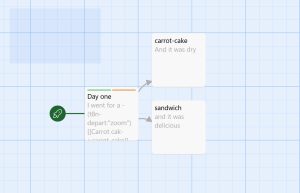
I want to create a story with choices for this project, so here’s me playing around in twine.
DAYS 7 TO 13
A week of silence.
I have two types of artistic processes.
With others. In a rehearsal room. All flow.
I am fast. Constant. Full of ideas. I love mistakes
and errors, through which I find new ways of
seeing the piece.
It’s a process that is very open, intense and wakes
me up at nights with more. More. MORE.
The other type is this – working alone.
Instead of the constant flow and intensity,
I stop. I become observant, slow – it feels like
being stuck. I ponder choices and all of them
seem wrong.
It takes a while. Until, through that stillness,
a pathway emerges.
Day 5 and Day 6 were for rest –
rest is important in everything.
Day 4
Movie night time – I’ve done research into what has been created
on the theme of online abuse and bullying – mostly series, documentaries
and movies, as I live in the middle of island and have no access to
galleries or theatres.
I would love some recommendations! What should I watch – or is there
a play or an exhibition on somewhere that I really should see?
Day 3
The skill of repair
Lately, I have been thinking of the sentence ‘believe the victim’. I have been thinking about it because of a victim I know who has decided to use the dress of victimhood as a preacher’s cape that excuses unreasonable demands. I have been thinking of believing the victim because the former Finnish Prime Minister has written a book where she positions herself into disadvantage because she is a woman – a victim of patriarchal society and its ever-detrimental power structure. I have been thinking of the sentence, because I don’t think being a victim should be used as a lever for power.
At this point, before you yell at me, I would like to point out I do think we should always believe the victim. It is much easier to take the side of the oppressor – all one has to do is do nothing – whereas believing the victim means becoming aware, and becoming aware is a demand for action, and action, well. That gets us involved. And it’s always messy, and complicated and we think we should get to the bottom of what really happened to be able to act from an informed position.
And that I don’t believe in. Not when we are talking about believing the victim.
See, I have also been thinking about a pair of woolen socks in my drawer with holes in them, and how I refuse to throw them away because I might one day repair them. I have been thinking about the skill of repair, and how we are so quick to discard what doesn’t function – to replace it with something new. I have been thinking about two separate occasions where I was the victim of unwanted sexual attention that escalated into physical contact, and how, after both incidents, I confronted the person who violated my right to decide who touches me.
One responded with complete denial and blamed me. I, quite frankly, still hate them. The other – they were baffled at first, walked away and then returned to me to say, “I’m sorry, I shouldn’t have done that.” And through that acknowledgment of their actions, they allowed me to repair my relationship with them. I know I can fix the holes in my woolen socks in the drawer, because I am aware there are holes in them; I could fix the gap between us because he accepted it was there.
Validation. Affirmation. Support. That’s what believing the victim is about. Not about truth, or blame, or figuring out who did what – all things that have a purpose later in the process – but when someone comes to you with a pain, you believe them, so that which is broken can become accepted. You believe them, even when you know the perpetrator and think they would never do that. You just believe them.
That is the skill of repair. That is how we get better.
And that is how believing the victim doesn’t become a lever for power.
Day 2
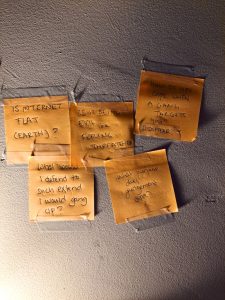
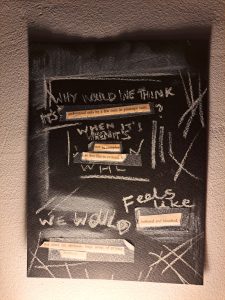
I haven’t decided on anything on this project yet – except for it’s theme.
I love working this way, exploring possibilities and finding things I don’t
expect. I spent some time with the colour orange making orange dye out
of carrots, underlining things with orange pens from an orange book – and
so on. It might seem nonsensical, and it is – but it’s all meant for shaking up
the approach, so one doesn’t do what one always does.
 _________________________________________
The project – day 1
25.11.2025 – I am a bit late starting today, delayed by sadness in the family.
Getting to know the campaign better, googling resource material – abundance of
it from different organisations, all very neat and effective. A different reality to
what I’ve witnessed online, most recently a week ago when a colleague got
an overwhelming negative response onto a post she made.
One of the main horrible things of online violence is that it often gathers up
a gang of bullies, targeting one individual. The anonymity or the sense of
of anonymity and sense of distance online allows this to happen so easily.
Have you ever been dragged into arguing against a stranger for a cause you believed in
because a bunch of people were already doing it?
The colour for the campaign is orange, and to bring this out of the analytical, I will do a few orange things.